




 6/30/2026 9:46:54 AM
 377
377Choosing a flavor supplier is not only a purchasing decision. For food and beverage manufacturers, it is often a product development decision, a quality control decision, and sometimes even a brand strategy decision.
A flavor may represent only a small percentage of the final formula, but it can strongly influence how consumers perceive the product. The first aroma, the taste balance, the aftertaste, the stability during storage, and even the emotional impression of a food or beverage product can all be affected by flavor selection.
This is why choosing the right flavor supplier matters. A reliable supplier should not only provide a catalog of flavor names. It should help manufacturers understand application conditions, adjust flavor profiles, solve stability problems, and turn product ideas into commercial-ready solutions.
For beverage brands, bakery manufacturers, dairy producers, confectionery companies, snack brands, and OEM/ODM factories, the right flavor partner can reduce development risk and improve product success.

Flavor Is More Than a Nice Aroma
Many people outside the industry think flavor selection is simple: smell the sample, choose the best one, and add it to the product. In real food manufacturing, the process is much more complex.
A flavor that smells excellent from the bottle may perform differently in the final product. Once it is added to a beverage, bakery filling, dairy drink, candy, sauce, or powder mix, the flavor interacts with water, fat, protein, sugar, acid, starch, heat, packaging, and storage conditions.
For example, a mango flavor may smell rich and attractive in the lab, but it may become too heavy in sparkling water. A lemon flavor may seem bright at first, but may fade after pasteurization. A vanilla flavor may work well in milk, but taste weak in a plant-based beverage with oat or soy notes.
This is why a professional flavor supplier should understand not only aroma creation, but also food application. The best flavor is not always the strongest one. It is the one that performs correctly in the real product system.
Understand Your Product Application First
Before choosing a flavor supplier, manufacturers should clearly understand their own product application. Different product systems require different types of flavors, different dosage ranges, and different stability requirements.
A flavor for clear sparkling water must usually be clean, bright, and stable in an acidic water-based system. A flavor for bakery products may need stronger heat resistance and better performance in fat-containing systems. A flavor for dairy drinks must work with milk protein, fat, sweetness, and sometimes fermentation notes. A flavor for plant-based beverages may need to mask cereal, beany, nutty, or earthy off-notes.
Powder products create another set of challenges. Flavor needs to survive drying, storage, transportation, and reconstitution. The aroma should remain stable in the powder and release properly when mixed with water or milk.
This is why a good supplier should ask questions before recommending samples. What is the product base? Is it water-based, oil-based, dairy-based, plant-based, or powder-based? Will it be heated, baked, pasteurized, UHT processed, or spray dried? What is the target shelf life? What is the desired flavor direction: fresh, creamy, fruity, sweet, roasted, sour, botanical, or functional?
A supplier that understands application details is more likely to provide a flavor that works in production, not just in a sample bottle.
Check Whether the Supplier Offers Application Support
Application support is one of the most important differences between a simple flavor trader and a professional flavor manufacturer.
In food and beverage development, customers often need more than a flavor sample. They may need help adjusting dosage, improving stability, balancing sweetness, masking off-notes, or matching a market product. This requires technical knowledge and application testing.
For example, a beverage company developing a low-sugar fruit drink may find that the taste becomes thin after sugar reduction. A flavor supplier with application experience may suggest adjusting the fruit top note, adding a fuller middle note, or using a flavor system that improves sweetness perception.
A bakery manufacturer may need a butter flavor that remains stable after baking. A dairy brand may need a strawberry flavor that works well with yogurt acidity. A plant-based drink producer may need a vanilla or chocolate flavor that covers beany notes without becoming artificial.
These are not simple catalog choices. They are application problems.
A strong flavor supplier should be able to support product testing, recommend suitable flavor types, and help customers move from concept to finished product more efficiently.
Evaluate Customization Capability
Every food brand wants differentiation. If all manufacturers use the same standard flavor, their products will taste similar. Custom flavor development gives brands more room to create unique product identity.
Customization does not always mean starting from zero. Sometimes it means adjusting sweetness, acidity, creaminess, freshness, fruit ripeness, roast level, or aftertaste. A customer may want a mango flavor that feels more tropical, a peach flavor that tastes more like white peach, a milk flavor that is less sweet, or a lemon flavor that is suitable for low-sugar sparkling water.
A professional flavor supplier should be able to modify flavor profiles according to product goals. This is especially important for export-oriented brands, because taste preferences differ across regions.
For example, Southeast Asian markets may prefer stronger tropical fruit notes and richer sweetness. European markets may prefer cleaner, less sweet, and more natural profiles. Middle Eastern markets may accept floral, creamy, or rich fruit directions. North American products may need familiar but modern profiles that fit low-sugar and functional trends.
Customization allows manufacturers to create flavor systems that match both product technology and market preference.
Do Not Choose a Supplier Based Only on Price
Price is important in food manufacturing, but flavor purchasing should not be based only on the lowest quotation. A low-cost flavor may look attractive at first, but if it causes instability, weak taste, high dosage, poor shelf-life performance, or consumer rejection, the real cost becomes much higher.
A better question is not simply “How much does this flavor cost per kilogram?” The better question is: “How does this flavor perform in my final product, and what is the effective cost in application?”
Sometimes a more concentrated or better-balanced flavor may have a higher unit price but a lower dosage. Sometimes a cheaper flavor may require more usage and still not deliver the desired result. In other cases, a low-quality flavor may create artificial notes or aftertaste problems that are difficult to correct later.
For professional manufacturers, value should be evaluated through performance, stability, dosage efficiency, technical support, and consistency—not price alone.
A good flavor supplier should help customers find the right balance between quality and cost.
Pay Attention to Stability and Processing Conditions
Flavor stability is one of the most important technical factors in food and beverage production. A flavor must survive the conditions of the actual product process.
Beverages may go through hot filling, pasteurization, UHT treatment, carbonation, acidic pH, or long shelf-life storage. Bakery products may face high baking temperatures. Confectionery may involve cooking, cooling, fat crystallization, or sugar systems. Dairy and plant-based drinks may contain protein, fat, stabilizers, and sometimes fermentation conditions.
A flavor that performs well on day one may change after two weeks, one month, or six months. It may fade, become harsh, separate, or develop an off-note. This is why application testing and stability evaluation are essential before commercial production.
A reliable flavor supplier should understand how processing affects flavor performance. The supplier should also recommend suitable flavor types, such as water-soluble flavors, oil-soluble flavors, powder flavors, emulsions, or heat-stable systems, depending on the product application.
Look for Consistency and Quality Control
Food manufacturers need consistency. Once a product is launched, consumers expect the same taste every time they buy it. If the flavor quality changes from batch to batch, the final product may lose consistency.
This is especially important for brands selling across different markets or through large retail channels. Even small changes in flavor profile can affect consumer perception.
A professional flavor supplier should have quality control systems to manage raw materials, production processes, batch consistency, documentation, and product specifications. The supplier should also be able to provide necessary documents for business cooperation, export, and product registration when required.
For international customers, documentation may include specification sheets, allergen information, halal status, MSDS, COA, ingredient statements, or regulatory-related support depending on the market and product type.
Strong quality control does not only protect the supplier. It protects the customer’s brand.
Communication Speed Matters
In product development, timing is often critical. A customer may need samples for an urgent project, a revised flavor for a new formula, or technical feedback before a production trial. Slow communication can delay the entire product launch.
A good flavor supplier should respond clearly and efficiently. More importantly, the supplier should understand the customer’s development goal. If a customer says, “We need a cheese flavor but not sweet,” the supplier should understand that this is not only a flavor name request. It is an application and sensory direction that may require a more savory dairy profile with reduced sweet creamy notes.
Good communication saves time. It helps avoid repeated sample failures and makes development smoother.
For B2B food and beverage customers, a supplier’s response quality often shows how well it can support real projects.
Think Long-Term, Not One-Time
Flavor development is rarely a one-time transaction. As brands grow, they may need new product lines, seasonal flavors, cost optimization, market-specific versions, or updated formulas. A reliable flavor supplier can become a long-term innovation partner.
For example, a beverage brand may start with one fruit flavor, then later expand into tea drinks, dairy drinks, functional beverages, and powdered beverage mixes. A bakery manufacturer may begin with vanilla and butter flavors, then develop chocolate, cheese, fruit, cream, and nut profiles. An OEM factory may need flexible flavor support for many different customer projects.
A supplier that understands the customer’s product direction can support faster development over time. It can also help build a more consistent flavor identity across different product categories.
This long-term value is often more important than one successful sample.
What to Ask Before Choosing a Flavor Supplier
Before starting cooperation, manufacturers can ask several practical questions.
Can the supplier provide flavors for your specific application? Does it offer water-soluble, oil-soluble, powder, liquid, emulsion, or heat-stable flavor systems? Can it customize flavor profiles based on your target product? Can it support application testing? Does it understand your processing conditions? Can it provide documentation for export or quality review? Is the communication clear and efficient?
The goal is not to find a supplier that says “yes” to everything. The goal is to find a supplier that understands the product challenge and can provide realistic technical support.
A professional supplier should be able to explain why a certain flavor type is suitable, what risks should be tested, and how the flavor can be adjusted if the first sample is not perfect.
Conclusion
Choosing the right flavor supplier is a critical step for food and beverage manufacturers. Flavor affects not only aroma and taste, but also product stability, consumer experience, brand differentiation, and commercial success.
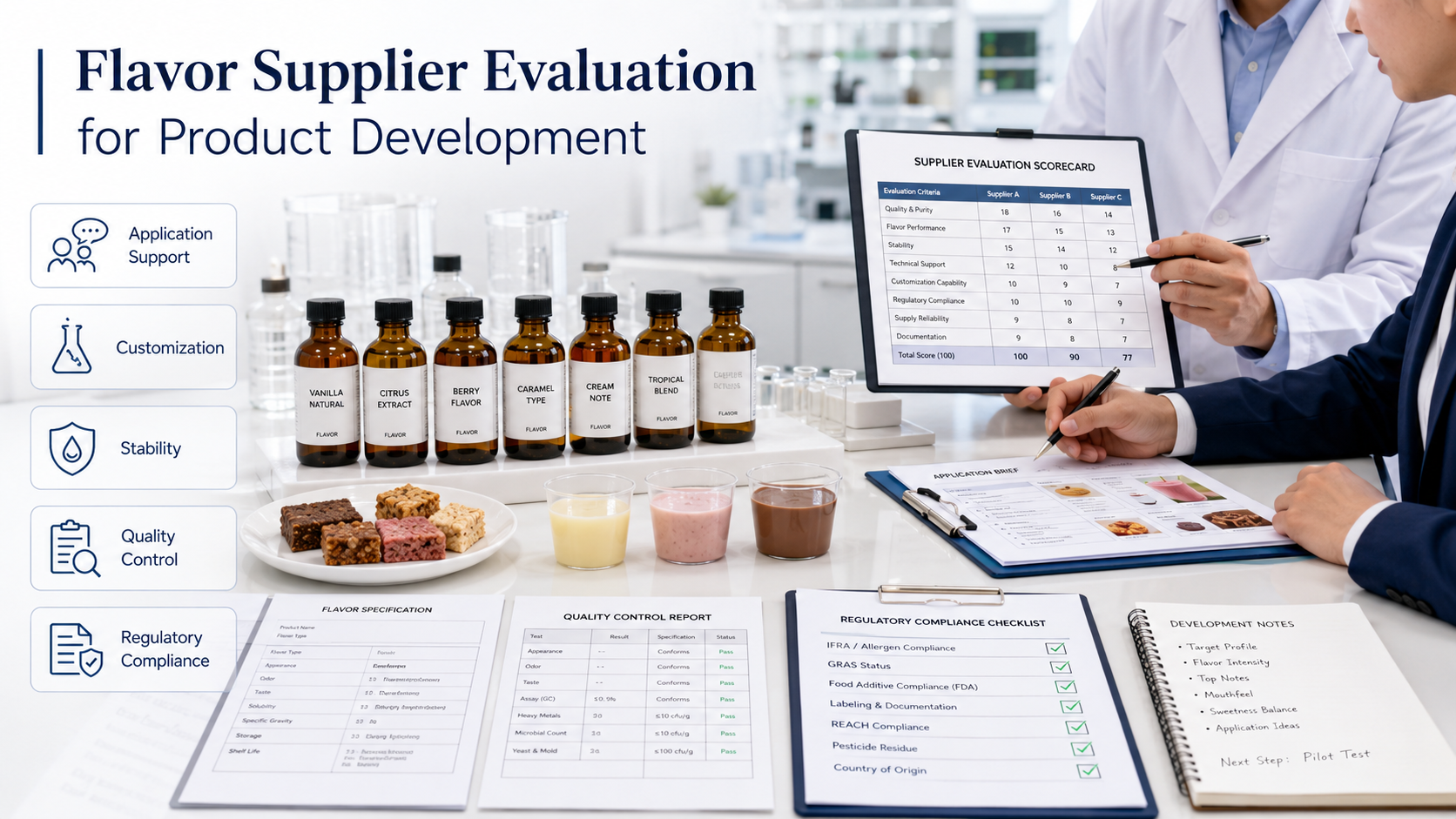
A reliable flavor supplier should understand application systems, offer customization, provide technical support, maintain quality consistency, and communicate effectively. The best supplier is not simply the one with the longest flavor list or the lowest price. It is the one that helps manufacturers develop products that taste good, perform well, and succeed in the market.
For food and beverage brands, flavor should be treated as a strategic ingredient. With the right supplier, a product idea can become a stable, attractive, and market-ready product.